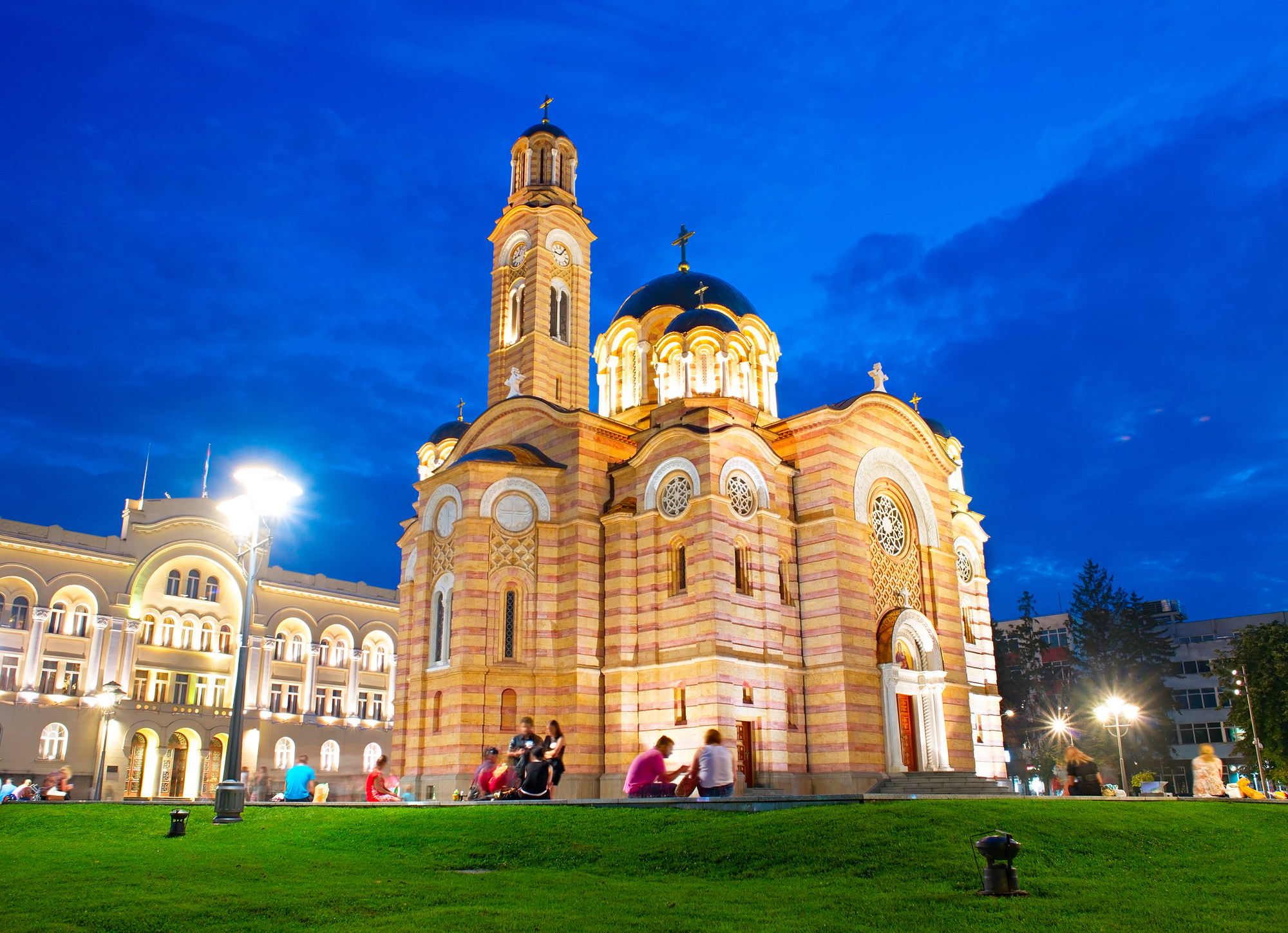
The Diocese of Banja Luka (Latin: Dioecesis Banialucensis; Croatian: Banjolučka biskupija) is a Latin Church diocese of the Catholic Church in western Bosnia. The diocese is centred in the city of Banja Luka, Republika Srpska, Bosnia and Herzegovina.
Erected on July 5, 1881, the diocese is a suffragan of the Archdiocese of Vrhbosna, as the Diocese of Banjaluka. In 1985, the name of the diocese was split into the current diocese of Banja Luka.
The current bishop of Banja Luka is Rev. Željko Majić.
History
Christianity arrived on the territory of the present-day diocese of Banja Luka during Roman rule in the first century AD. Christians and bishops from the area settled around two metropolitan seats, Salona and Sirmium. In this area, there was at that time the seat of at least one diocese, Diocese of Baloie (probably near Šipovo), whose bishop participated in the church synod of Salona in 530.
After the barbaric invasion and after the settlement of Slavic tribes, these regions belonged to the surrounding dioceses: Split, Nin, Knin, Krbava and Bosnia, and the area of today's Banja Luka and the entire northern region was part of the Diocese of Zagreb. The rich life of the Catholic Church in this region before falling under Ottoman rule is testified by numerous churches from ancient and medieval times discovered on the territory of the Diocese. The highest concentration was in the Bihać Deanery area.
The Ottoman conquest that brought the demolition of Catholic churches and the islamization of the population, almost destroyed the presence of the Catholic Church in these areas, except for southern regions around Livno. The City of Bihać resisted the longest, until 1591. From the time of the Ottoman conquest, the pastoral clergy in these parts were almost exclusively Bosnian Franciscans. On the Livno area was recorded the presence of Glagolitic Catholic secular priests who celebrated the Slavic liturgy. The bishops did not dare to come to parts of their dioceses that fell under Turkish rule. That is why, in 1735, instead of the existing dioceses, the Holy See founded the Apostolic Vicariate in Ottoman Bosnia (Vicariatus Apostolicus Bosniae Othomanae). The Catholic church in Banja Luka was particularly hard hit during the War of the Holy League (1683–1699). In 1737 parish church in Banja Luka was burned and numerous believers migrated to the Habsburg possessions.
After Bosnia Vilayet came under Austro-Hungarian rule in 1878, Pope Leo XIII restored the vilayet's church hierarchy. In Ex hac augusta, his 5 July 1881 apostolic letter, Leo established a four-diocese ecclesiastical province in Bosnia and Herzegovina and abolished the previous apostolic vicariates. Sarajevo, formerly Vrhbosna, became the archdiocesan and metropolitan seat. Its suffragan dioceses became the new dioceses of Banja Luka and Mostar and the existing Diocese of Trebinje-Mrkan.
After the renewal of the regular hierarchy, the Diocese was governed by the apostolic nuncio in Vienna, and from 1883 to 1884, by the Archbishop of Vrhbosna, Josip Stadler, who served as an apostolic administrator of the Diocese.
The original Cathedral of Saint Bonaventure in the city was built in 1887. However, an earthquake in 1969 levelled the church. Banja Luka's current cathedral was built in 1974.
At the time of its founding, the Diocese had some 36,000 believers. This number has accelerated rapidly with the arrival of the Austrian authorities. During the next decades, numerous Poles, Italians, Germans, Czechs and others moved into the area of the Diocese.
During the Second World War and after the war, the Diocese was catastrophically harmed. One-third of all the parishes (13) have completely perished, in 10 of the parishes the number of parishioners dropped significantly, and all the others were seriously injured. With a large number of killed believers, the diocese suffered a severe loss of priests. During the war and after the war, at least 30 priests were killed. The Holy See started the process of beatification of 4 of them on 21 December 2014: Juraj Gospodnetić, Waldemar Maximilian Nestor, Antun Dujlović and Krešimir Barišić.
Ordinaries
Apostolic Administrators
Bishops
Auxiliary Bishops
Demographics
Diocese of Banja Luka has a population of 550,300. As of 2012, 35,428 (6.44% of the population) are Roman Catholics.
The city of Banja Luka, and much of the territory that the diocese covers contains an Orthodox Christian majority. The Bosnian War greatly affected the diocese. Virtually all of the churches in the bishopric sustained some damage, and many were destroyed. Many Catholics were expelled from the region or fled, leaving only a fraction remaining. Bishop Komarica has been urging people to return, to mixed results.
Historical Catholic population
The historical Catholic population is given in the following chart:
Deaneries
Churches
Parish churches
This is a list of Parish churches by deanery:
Deanery of Banja Luka
- Church of the Visitation of the Blessed Virgin Mary, Banja Luka
- St. Vitus's Church, Barlovci
- Church of the Assumption of the Blessed Virgin Mary, Ivanjska
- Church of the Assumption of the Blessed Virgin Mary, Banja Luka
- Saints Peter and Paul Church, Motike
- Church of Saint Anthony of Padua, Banja Luka
- Church of Saint Therese of the Child Jesus, Presnače
- Saints Peter and Paul Church, Šimići
- Saint Joseph's Church, Trn
Deanery of Bihać
- Church of Saint Anthony of Padua, Bihać
- Church of the Exaltation of the Holy Cross, Bosanska Dubica
- Saint Joseph's Church, Bosanska Gradiška
- Holy Trinity Church, Novi Grad
- Saint Joseph's Church, Drvar
- Church of Saint Leopold Mandić, Ljubija
- Saint Joseph's Church, Prijedor
- Saint John the Baptist Church, Ravska
- Church of the Assumption of the Blessed Virgin Mary, Sanski Most
- Church of the Nativity of the Blessed Virgin Mary, Sasina
- Church of Saint Anthony the Hermit, Majdan
- Church of Saint Anthony of Padua, Stratinska
- Sacred Heart Church, Šurkovac
Deanery of Bosanska Gradiška
- Church of Saint Roch, Gradiška
- Saint John the Baptist Church, Bosanski Aleksandrovac
- Church of the Assumption of the Blessed Virgin Mary, Dolina
- St. Francis' Church, Mahovljani
- Saint Joseph's Church, Nova Topola
Deanery of Jajce
- Church of the Assumption, Jajce
- Saints Philip and James Church, Mrkonjić Grad
- Church of the Nativity of the Blessed Virgin Mary, Ključ
- Church of Saint Elias, Liskovica
Deanery of Livno
- Church of Saint Elias, Glamoč
- All Saints Church, Livno
- Immaculate Conception Church (Vidoši)
- Saints Peter and Paul Church, Livno
- Saint John the Baptist Church, Livno
- St. Michael's Church, Livno
- St. Francis' Church, Bila
- Church of Saint Elias, Bosansko Grahovo
- Church of Saint Anthony of Padua, Čuklić
- Saint Joseph's Church, Lištani
- Church of the Nativity of the Blessed Virgin Mary, Ljubunčić
Deanery of Prnjavor
- Church of Saint Anthony of Padua, Prnjavor
- Church of Saint Leopold Mandić, Dragalovci
- Church of the Nativity of the Blessed Virgin Mary, Kotor Varoš
- Church of the Nativity of the Blessed Virgin Mary, Kulaši
- Church of the Assumption of the Blessed Virgin Mary, Sokoline
- St. Francis' Church, Vrbanjci
Religious orders
The Diocese of Banja Luka is home to a small number of religious orders and congregations. While there are not as many today in 2013 as there were in 1950, they still make up a large population of the diocese.
In 1950, there were 71 religious priests, 4 male religious, 310 nuns and sisters ministering in the Diocese.
As of 2013, 47 priests of religious orders, 92 religious sisters and nuns minister in the diocese.
Male Religious Orders Currently in the Diocese
- Franciscan Friars of Bosna Srebrena
- Order of Cistercians of the Strict Observance (Trappists)
- Carmelites
Female Religious Orders Currently in the Diocese
- Daughters of Charity of Saint Vincent de Paul
- Servants of the Infant Jesus (Province of Split), established by Josip Stadler, archbishop of Vrhbosna
- School Sisters of St. Francis (Bosnian-Croatian Province of Immaculate Heart of Mary)
- Adorers of the Blood of Christ
- Missionaries of Charity
Saints, Blesseds & Venerables of Banja Luka
- Blessed Ivan Merz – Bosnian-Croatian lay academic, beatified by Pope John Paul II on a visit at Banja Luka, Bosnia and Herzegovina on June 23, 2003. Ivan Merz promoted the liturgical movement in Croatia and together with Ivo Protulipac created a movement for the young people, "The Croatian union of the Eagles" ("Hrvatski orlovski savez"), inspired by the "Eucharistic Crusade," which he had encountered in France.
References