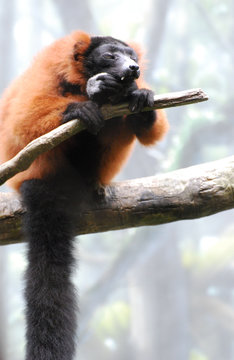
True lemurs, also known as brown lemurs, are the lemurs in genus Eulemur. They are medium-sized primates that live exclusively on Madagascar.
The fur of the true lemurs is long and usually reddish brown. Often, sexual dimorphism in coloration (sexual dichromatism) is seen, such as in the black lemur. True lemurs are from 30 to 50 cm (12 to 20 in) in length, with a tail that is as long or significantly longer than the body. They weigh from 2 to 4 kg (4 to 9 lb).
True lemurs are predominantly diurnal forest inhabitants, with some species preferring rain forests, while others live in dry forests. They are skillful climbers and can cross large distances in trees by jumping, using their nonprehensile tails to aid in balancing. When on the ground, they move almost exclusively on all four legs. True lemurs are social animals and live together in groups of two to 15 members.
The diet of the true lemurs is almost exclusively herbivorous – flowers, fruits and leaves. In captivity, they have been shown to also eat insects.
Gestation is 125 days. During the summer or early fall (shortly before the beginning of the rainy season), the females birth their young, usually two offspring. The young clasp firmly to the fur of their mother, then ride on her back when they are older. After about five months, they are weaned, and they are fully mature around 18 months of age. The life expectancy of the true lemurs can be up to 18 years, but this can be longer in captivity.
Classification
- Genus Eulemur
- Common brown lemur, E. fulvus
- Sanford's brown lemur, E. sanfordi
- White-headed lemur, E. albifrons
- Red lemur, E. rufus
- Red-fronted lemur, E. rufifrons
- Collared brown lemur, E. collaris
- Gray-headed lemur, E. cinereiceps
- Black lemur, E. macaco
- Blue-eyed black lemur, E. flavifrons
- Crowned lemur, E. coronatus
- Red-bellied lemur, E. rubriventer
- Mongoose lemur, E. mongoz
Survival
Brown lemurs are able to survive degraded forest that would cut off their food supply through expanding their range throughout the terrain.
References
External links
- ARKive - images and movies of the collared brown lemur (Eulemur collaris)
- Primate Info Net Eulemur Factsheets
Further reading
- Markolf, M.; Kappeler, P. M. (2013). "Phylogeographic analysis of the true lemurs (genus Eulemur) underlines the role of river catchments for the evolution of micro-endemism in Madagascar". Frontiers in Zoology. 10 (1): 70. doi:10.1186/1742-9994-10-70. PMC 3835867. PMID 24228694.
- Campera, Marco; et al. (2014). "Effects of Habitat Quality and Seasonality on Ranging Patterns of Collared Brown Lemur (Eulemur Collaris) in Littoral Forest Fragments". International Journal of Primatology. 35 (5): 957–975. doi:10.1007/s10764-014-9780-6. S2CID 15249267.